
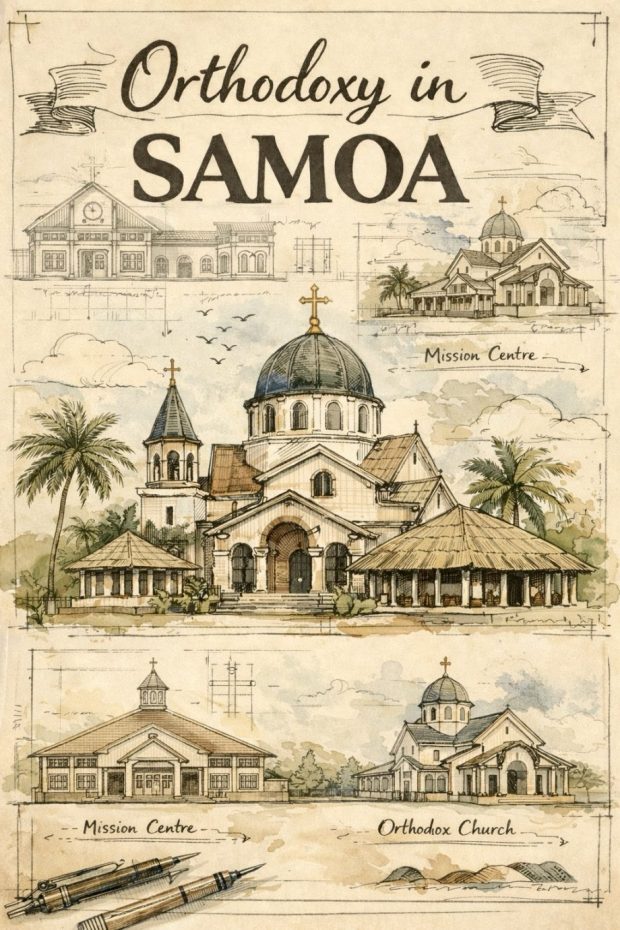
Orthodoxy in Samoa
When the Gospel was first preached on the Samoan islands, the story of the Triune God was received by a people already formed by reverence, communal life, and an instinct that life itself is received as a gift from above. This is why Christianity took root so deeply and so quickly. The Samoan heart recognized the truth of this story, not as an idea, but as life.
Yet recognition is not the same as fulfilment. In the Acts of the Apostles, the preaching of the Gospel is never the end of the story. The Apostles do not merely proclaim Christ; they gather the faithful, they establish communion, and above all, they break bread.
“They continued steadfastly in the apostles’ teaching and fellowship, in the breaking of bread, and in the prayers” (Acts 2:42).
This single verse reveals the Church as a living reality. Fellowship (koinonia) is not only friendship, but communion in the life of the Holy Trinity, made visible as the Body of Christ. The breaking of bread is not an ordinary meal, but the Holy Eucharist, the liturgical act through which the risen Lord gives Himself to His people. The prayers are not spontaneous expressions alone, but the ordered worship of the Church, sanctifying time itself.
The Church, therefore, is born not only from the preached Word, but from the Mystery of the Incarnate Word, made present in the Holy Eucharist.
Samoa received the preached Word with faith. What it has long awaited is the Church in which human life is gradually transfigured in Christ, where prayer, sacraments, and fellowship open the heart to the life of God, as handed down from the Apostles.

At the heart of Samoan culture stands fa’aaloalo—a reverence expressed as an attitude of patience, faithfulness, and restraint. One does not rush what is sacred. Elders are honoured. Silence has meaning. Authority is received, not seized.
This way of life is profoundly scriptural. Before Pentecost, the disciples did nothing spectacular. They gathered together. They prayed. They waited. The Church was not born from strategy or urgency, but from obedience and hope.
For many years in Samoa there has been prayerful longing, and waiting for Orthodoxy. There has been no resident priest, no Divine Liturgy regularly served, no Mission Centre around which Liturgical life could gather. This absence was not emptiness. It was waiting. And in the Christian life, waiting is never wasted time.

Orthodox mission does not begin with numbers, visibility, or success. In the Acts of the Apostles, it often begins quietly: in a household, in a borrowed space, in a small community sustained by prayer and hope. The Kingdom of God grows without noise.
This is why the present moment in Samoa matters so deeply. After long years of prayer and anticipation, the Mission Centre and church dedicated to St John the Apostle, the Beloved Disciple, is now beginning to rise. A foundation stone is about to be placed.
Orthodoxy in Samoa is not an act of conquest or correction. It is an invitation to abide in Love—to dwell in Christ through the sacramental life of His Church.

St John is the Apostle of love and abiding. “Remain in Me,” Christ says in the Gospel he alone records.
A young man, still waiting for the Church to come to his island, recently described his own journey. Having first encountered Christ in an pentecostal setting, he searched deeply, prayed earnestly, and studied the history of the Church. What he discovered was not a rejection of where he began, but a realisation that something essential was missing.
When he finally stepped into an Orthodox church abroad, he wrote simply: “Something was different. I felt at home.”
This recognition is not merely intellectual. It is Ecclesial and Sacramental. Like the seekers we meet in the Acts of the Apostles, his heart recognized what his eyes had not yet seen in his own island. He waits now with hope—waiting for the Church to come, for the fullness of the gifts of the Holy Spirit to be offered, and for the life he has glimpsed to take root where he lives.
The Gospel has long been loved in Samoa. Reverence has long been practiced. Prayer has long been offered. What Orthodoxy brings is not a different Christ, but the fullness of communion with Him—the sacramental life that unites heaven and earth, the living and the departed, the past and the age to come.
In this quiet beginning—before the walls are complete, before the Divine Liturgy is regularly served—we find ourselves exactly where the early Church once stood: trusting that what has been planted in faith will be brought to life by grace.
The seed is already in the ground. The stone is about to be set.