
“It is the day of Resurrection, let us be radiant, O you peoples: Pascha, the Lord’s Pascha!”
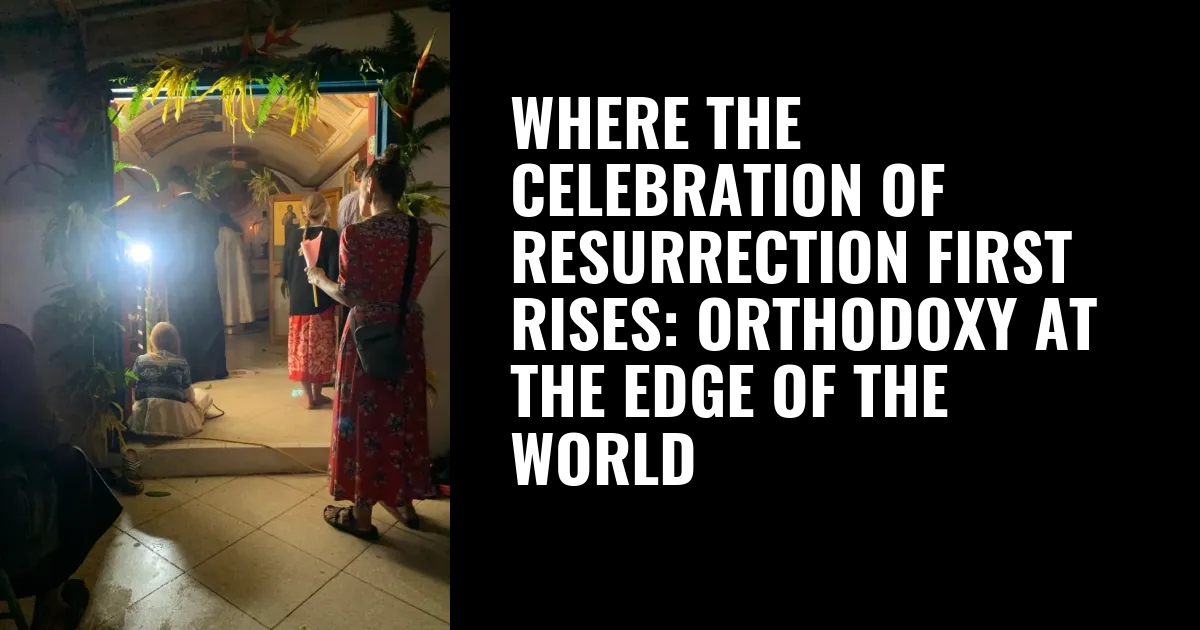
Before any other land utters the words, it is on Tongan soil that the Feast of Resurrection breaks forth into the world. In the far reaches of the Pacific, where the earth first greets the light of the Sun of each new day, the Kingdom of Tonga rises like a hymn before dawn. And it is here, in this archipelago shaped by tradition and tide, that the Orthodox Paschal proclamation—“Christ is Risen!”—is first heard.
By the mystery of its geography, Tonga becomes the first voice of the Resurrection each year, the first echo of the empty tomb, the first corner of the world to cry out with joy into the silence of death.
To celebrate Pascha is to enter deeply into the mystery of the “ever new day”—not merely as a moment on the calendar, but as the liturgical and ontological center of time itself. The Church teaches that the Resurrection is not a past event, but the beginning of a new creation: the eighth day, the day without evening. In the Western Pacific, where the counting of each new day begins, the reality of this unwaning Day—the day beyond evening and morning—strikes differently. The darkness of Holy Saturday, thick and weighty, is broken in the light of Paschal Orthros, not only for those gathered in Nuku’alofa, but—mystically—for the entire oikoumene.
Yet this light shines in a land where the faith of the Gospel—introduced through Protestant missionaries nearly two centuries ago—has taken varied and sometimes fractured forms. Tonga, outwardly Christian in identity, is marked deeply by the presence of Mormonism which now claims over sixty percent of the population. Their official records count 166 congregations and more than 61,000 adherents. But Mormonism in Tonga is more than a religious affiliation; it is a cultural structure: well-funded, educationally driven, and socially cohesive. It has provided a sense of stability through its network of institutions, including seven schools—five middle schools and two high schools—among them the long-standing Liahona High School, founded in 1952.
Yet beneath this visible structure lie theological absences with profound implications. The Mormon faith does not proclaim the Cross as historic Christianity does, nor does it know the liturgical observance of Lent or Holy Week, culminating in the celebration of Pascha. It is a form of Christianity shorn of its axis, its scandal, and its glory. The Cross, in Orthodox understanding, is not an unfortunate moment in a divine plan, but the very throne of God, the place where glory and suffering meet, and where love is poured out even unto death. To abandon it is to forget the very grammar of our salvation. Holy Week is not simply a narrative; it is the cosmic drama of God’s descent into death and His rising again, that the world might be raised with Him. To live without this liturgical memory is to lose the heartbeat of the Gospel.
This is why Orthodoxy matters in Tonga—not as a rival denomination, but as the Church: the fullness of the faith, where death is faced and defeated, where Christ is encountered in the fullness of His humanity and divinity—as the Son of the living God, the second person of the undivided Trinity (Τριάδα), revealed through the love of the Father and in the communion of the Holy Spirit. Orthodoxy is not an ideological alternative. It is the revelation of life as communion—the transfiguration of time, body, and mind—the transfiguration of life itself.


But for Orthodoxy to be known, it must first be seen. And for it to be seen, it must be lived. The presence of the Church here is still young—humble in numbers, but rich in the treasure it bears. To awaken awareness among Tongans is not simply to speak of theological differences, but to reveal a vision of life where fasting leads to feasting, where the suffering of Christ becomes the healing of mankind, and where time itself is redeemed through the rhythm of the prayers and the Holy Mysteries of the Church.
But how shall they hear and see unless someone tells them, unless someone shows them? It will require education and beauty, the building of spaces where the sacred is encountered not as an idea, but as a presence. How shall they recognise the icon of Christ unless it is shown to them in flesh and blood—in persons transfigured by love, humility, and service? The task is not to argue or to coerce but to reveal. To live the life of the Church in such a way that the Tongan heart, already rich in communal love and reverence for sacred things, can recognise in Orthodoxy not something foreign, but something familiar at a deeper level—a homecoming, not a colonisation.
To speak of Orthodoxy in Tonga, then, is to speak of mission—not as conquest, but as offering; not as the imposition of ideas, but as the invitation into Mystery. It is to recognize that the Church does not arrive in Tonga as a stranger, but as the fullness of what the heart already longs for. And it is to know that the Resurrection—proclaimed first in these islands, before the rest of the world awakens—is the very foundation of this offering.
This Pascha in Tonga is not only the first of its kind,
but perhaps a beginning of many things.
A beginning of remembrance. A beginning of return.
A beginning of the Church revealing herself not in the voice of thunder,
but in the still small voice of Him who says, again and again,
“Behold, I make all things new.”
Kilisito kuo toitu’u!!!
Χριστός Ανέστη!!!
Christ is Risen!!!