
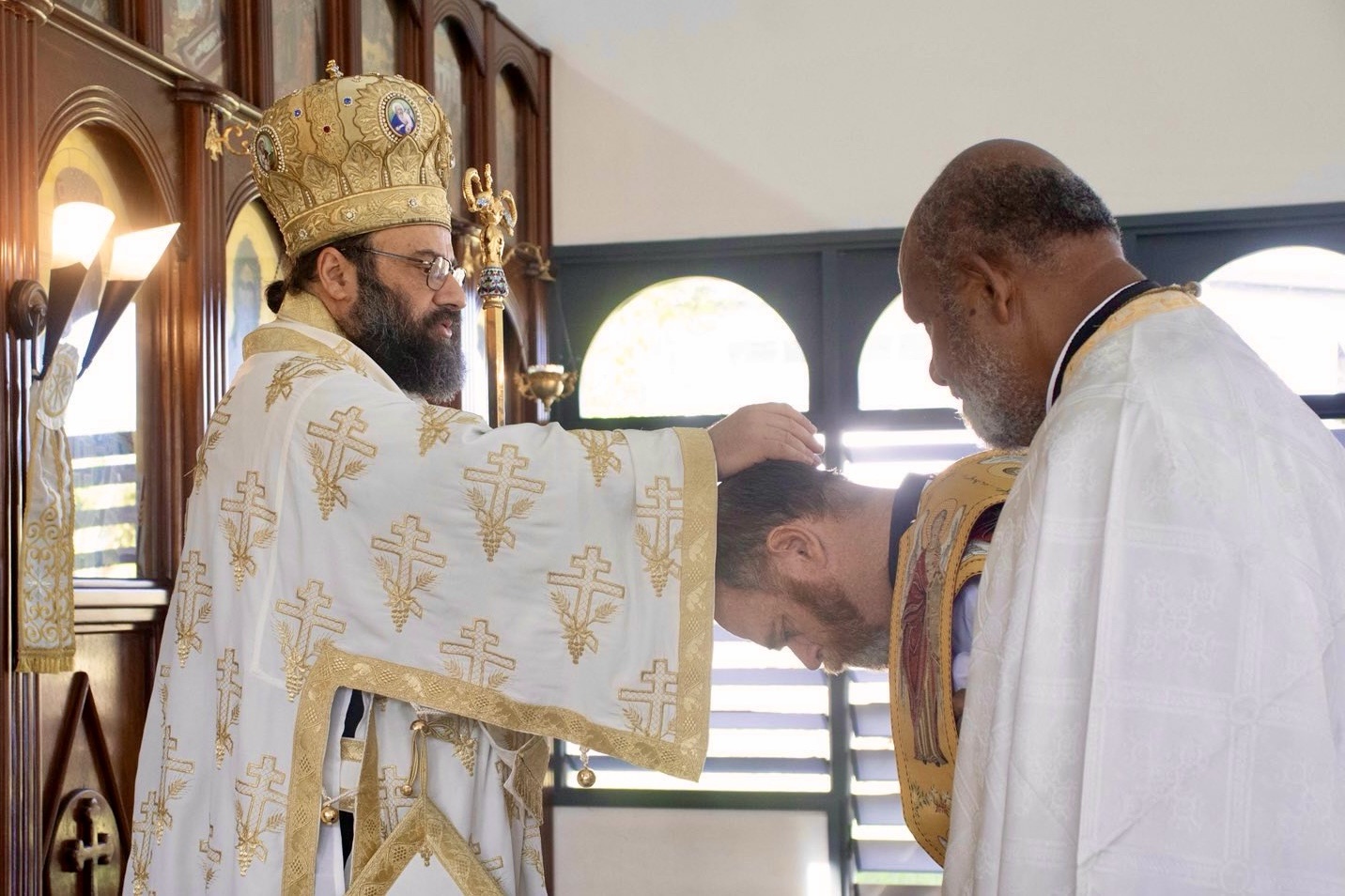
Some events in the Church take place without great ceremony or attention, yet they mark a quiet turning in the life of a community. The recent ordination of Fr. Timothy in Fiji was just such an event. Held in a modest church of Holy Trinity in Saweni, among people who had long prayed for a shepherd of their own, the service was simple and deeply prayerful. That our Metropolitan Myron ordained him on the Feast of Mid-Pentecost was no mere coincidence, but a quiet echo of the Church’s deeper rhythm: Christ, standing in the middle of the Feast, proclaiming that whoever thirsts should come to Him and drink. It was as though, on that day, the Lord’s voice was heard again—offering the Living Water not from afar, but through the voice and hands of one called to minister among them.
For the community, this moment was not only the ordaining of a man, but the quiet arrival of stability.
The priesthood in the mission is not built on success or numbers. It is made of presence, of faithfulness in small things, of bread broken and wine poured in a place where people are still learning what it means to believe. And perhaps that is the most beautiful thing: the Gospel here is preached not in thunder but in tenderness. In a voice that begins to speak their language. In hands that bless their children. In tears shared over graves and laughter around feast tables. The Word becomes flesh again—this time, here—because someone dared to stay, to serve, and to love.
As His Eminence characteristically said on the day of Ordination: “…dared to stay to be a servant of Love.”
and to allow Christ to be present in and through him, in ways he may never fully see. It is the beginning not of authority, but of communion, where priest and people grow together into the likeness of the One who came not to be served, but to serve.
To ordain a new clergyman is not merely to fill a vacancy or expand an administrative structure—it is to entrust a man with the mystery of the Church’s life. When a bishop lays hands upon one who is to become a deacon or priest, he does so not as an individual but as a bearer of the apostolic lineage, joining that man to a living chain that reaches back to Christ Himself. In the mission field, where clergy are few and the faithful scattered, such an ordination carries an even deeper weight. It is a sign of rootedness—a declaration that the Church is not visiting, but dwelling; not passing through, but planting herself in the soil of that place. A new priest means that the Divine Liturgy will be served, that confession will be heard, that the sacraments will be poured out—not in theory, but in the lived experience of a people who now have a shepherd among them in a land still becoming Orthodox.
To celebrate such a moment on Mid-Pentecost—the feast that stands in the middle of the Paschal season, looking back to the Resurrection and forward to the coming of the Spirit—is to recognise that the Church, too, stands “in the midst” of the people, offering Christ who is both risen and ever-present. The priest is not ordained to solve problems or create programs, but to stand in that same space—to teach, to nourish, and to invite others to drink from the wellspring of life that flows from Christ.


I remember once speaking with a priest who was serving in a small island, far from any centre, who told me about the moment he was ordained. He said, “When the Metropolitan laid his hands on me, I felt not elevation but weight—a sudden heaviness, as if the lives of those around me had come to rest on my shoulders.” For years, he served quietly, never with fanfare, but he served Divine Liturgies, blessed water in the homes of the people, buried the dead, baptised the children, prayed for everyone who would ask even in the dusk after all the work, and ceaselessly visited the sick and prayed for everyone whether or not they understood the words of the prayers.
“Most days,” he said, “I wasn’t sure if I was doing anything great. But when people started calling me ‘Father’—not out of habit, but because they knew I loved them—it was then I knew that Christ had come to dwell here.”
And so, the ordination becomes not simply a rite, but a proclamation: that Christ is present here, in this corner of the world, and He will not forsake His people. The newly ordained does not arrive as a stranger, but as one called to walk with the community—bearing their burdens, speaking their language, breaking the Bread of Life with and for them. In this way, the Archbishop’s hands, extended in ordination, reach beyond the moment—into the lives of the faithful, into the future of the Church in that land, and ultimately into the mystery of Christ who is always both Shepherd and Lamb, both High Priest and Sacrifice.

AXIOS! Father Timotheos!